Table Of Content

Perhaps his most famous work is the poster he designed for the 1923 Bauhaus Exhibition in Weimar, which has become an iconic example of Bauhaus graphic design. This poster showcased many key elements of the Bauhaus design philosophy, including geometric shapes, a balanced yet dynamic arrangement of elements, and a focus on typography. Joost Schmidt, another prominent figure of the Bauhaus movement, had a significant influence on modern graphic design that can still be seen today. He was a master craftsman in the Bauhaus's printmaking and advertising workshop and eventually became a teacher there. One prominent Bauhaus figure who pioneered new graphic design techniques is Herbert Bayer. Bayer's innovative use of typography and experimental layouts revolutionized graphic design in the 20th century.
Modernist architecture: the Bauhaus and beyond
He was invited to Bauhaus to give workshops on printing and painting, among many other practices. To honor his work, Klee’s grandson compiled his archives of notes, paintings, and artworks, and exhibited them in a museum designed by architect Renzo Piano. The Alan I.W. Frank House, Walter Gropius and Marcel Breuer1940Pittsburg, USA When the duo began teaching at Harvard’s Graduate School of Design, they were commissioned by Frank’s father to build him a family house. Their designs were not just limited to the architecture itself, but to the fittings and furniture as well, making the residence a truly unique property. Gropius House, Walter Gropius1938Lincoln, Massachusetts After fleeing Europe, Gropius and his wife settled in Massachusetts when he began teaching at Harvard’s Graduate School of Design. Back then, the United States were not yet familiar with the school’s principles and found the house to be remarkably bizarre and out of place.
Hannes Meyer and Bauhaus Dessau

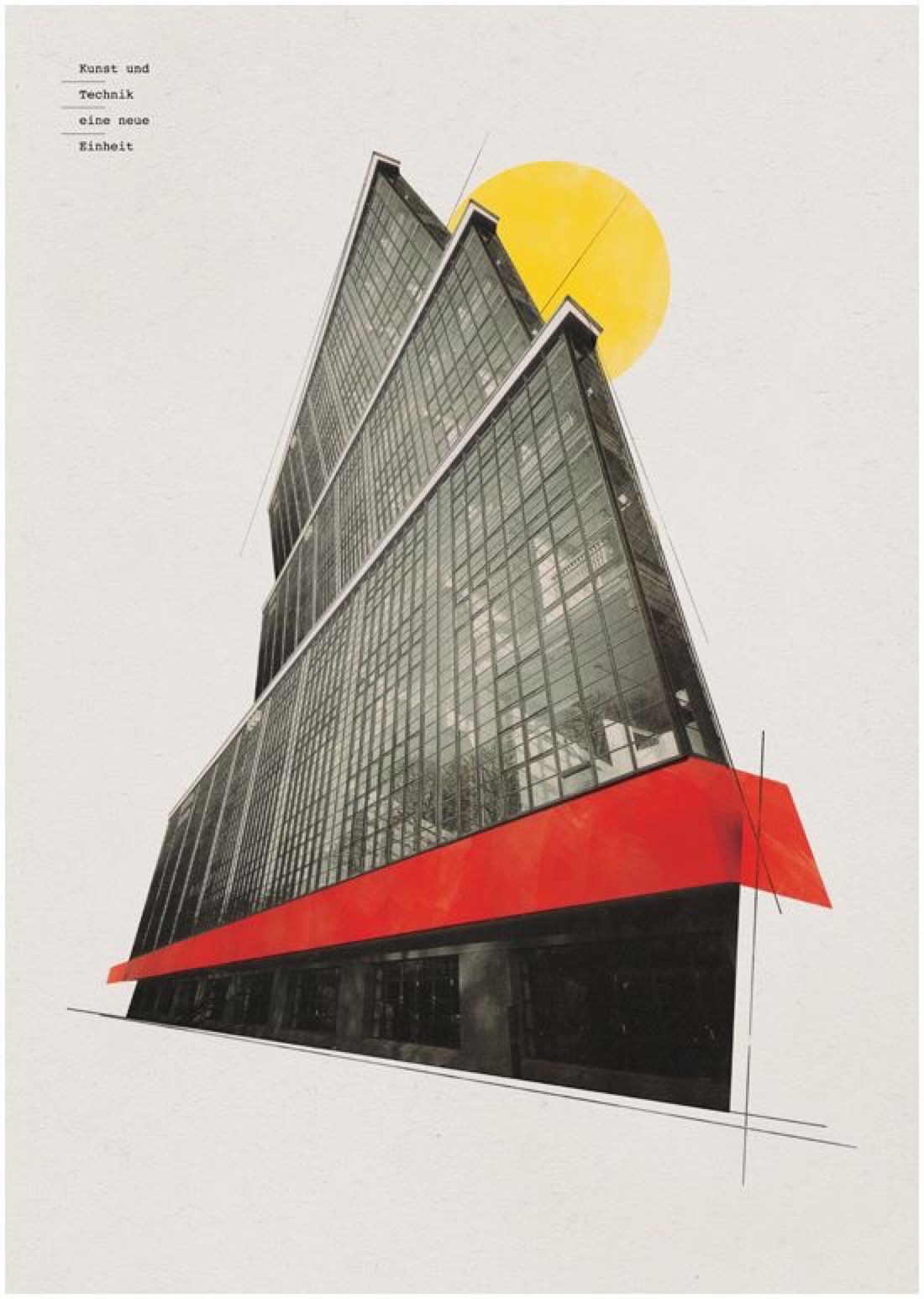
The Bauhaus building was a school which taught students how to use modern and innovative materials and mass produced fittings. It was made up of blocked buildings and used asymmetry and regularity, the building also featured a lot of windows which provides a clear view of the inside which contained workshops, studios and a vocational school where the teaching was conducted. The workshop wing was made up of 3 storeys and was connected to the vocational school by a two storey bridge, it was also connected to the 5 storey studio building by a one storey building. The Bauhaus was an art school that was radical in its uniting of art, craft, and technology in the years following the World War I. Its main goal was to improve people's living conditions through modern design.
Oskar Schlemmer's contribution to art schooling and theater
Many contemporary designs, from Apple products to IKEA furniture, owe a debt to the Bauhaus principles of simplicity, functionality, and the use of new materials and technologies. The school’s legacy lives on in the sleek, user-friendly design that characterizes so much of modern consumer goods. At first the Bauhaus focused on individual handmade craft, but the school soon shifted to a more industrial focal point, merging art and technology and emphasising mass production. Furnishings created there, such as Marcel Breuer's tubular-steel Club Chair and Marianne Brandt's light fittings, fit this ethos of standardisation and uniformity. While the early 20th-century trends of modernism influenced both movements, De Stijl placed a greater emphasis on abstraction and a reduction of form, while Bauhaus focused more on integrating art and technology into everyday objects. These contrasting approaches resulted in different visual aesthetics and design philosophies within the artistic movements.
The Harvard School was enormously influential in America in the late 1920s and early 1930s, producing such students as Philip Johnson, I. M. Pei, Lawrence Halprin and Paul Rudolph, among many others. In the late 19th century, Europe was a hive of research activity into the benefits of fresh air, exercise, and recouperative healing, ideas that quickly began traversing the Atlantic. There are direct connections between the sanitarium designs of Europe and New York, and what would later happen in California, according to Kilston. The Lovell Health House launched Neutra’s career—he described it as going from a starvation diet to a career—and helped create a template for sleek, streamlined homes. The look was liberally borrowed by the Case Study homes that would create a pattern library for midcentury modern residential design.
The White City
The Bauhaus was founded at a time when the German zeitgeist had turned from emotional Expressionism to the matter-of-fact New Objectivity. An entire group of working architects, including Erich Mendelsohn, Bruno Taut and Hans Poelzig, turned away from fanciful experimentation and towards rational, functional, sometimes standardized building. Beyond the Bauhaus, many other significant German-speaking architects in the 1920s responded to the same aesthetic issues and material possibilities as the school.
How to make animated social media posts
After his relocation to the United States in 1937, Gropius taught at the Graduate School of Design at Harvard University, and was seen as vital in introducing International Style architecture to America and the Anglophone world. So too was Mies van der Rohe, who arrived in the U.S.A in the same year as Gropius, becoming Director of the College of Architecture, Planning, and Design at the Illinois Institute of Technology. Four years earlier, Josef Albers had been appointed head of the painting programme at the legendary Black Mountain College in North Carolina, where his students included Robert Rauschenberg and Cy Twombly. After his own flight from Germany in 1933, the Jewish-born Hungarian László Moholy-Nagy formed what later became the Institute of Design in Chicago. Paepcke’s first pick to design the Institute was German architect and Bauhaus founder Walter Gropius.
The Bauhaus design style is marked by the absence of ornamentation and by harmony between the function of an object or a building and its design. Lastly, the Bauhaus style promoted mass production and accessibility, which contradicted the Nazi regime's elitist and exclusivist ideology. The Nazis advocated for a hierarchical society where only a select few had access to luxury and high-quality goods. The Bauhaus ethos of making design accessible to the masses was seen as undermining this perceived social order. Gropius successfully merged the Grand-Ducal Saxon School of Arts and Crafts with the Weimar Academy of Fine Art to establish the influential art and design school. Bauhaus' interdisciplinary approach, which merged art, craftsmanship, and technology, anticipated the integrated, cross-functional nature of contemporary design and creative work.
Bauhaus: Concepts, Styles, and Trends
Gropius declined, but instead suggested Herbert Bayer, a Bauhaus-educated Austrian designer who had spent much of the 1920s studying and teaching at the German art school before a stint as art director for Vogue Berlin. In 1938, the imminent onset of World War II prompted Bayer and his first wife, Irene Bayer-Hecht, to leave Germany for New York, and in 1946, at Paepcke’s invitation, Bayer moved with his second wife, Joella Synara Haweis, to Aspen. Van Beuren, trained as an architect, moved to Mexico in 1937 and was commissioned early on to design the interiors of the bungalows at the famous Flamingo Hotel in the resort city of Acapulco.
Thirdly, Bauhaus architecture embraces integrating art and technology and the collaboration of different disciplines and professions. Bauhaus architects worked closely with artists, craftsmen, engineers, and educators to create a holistic and interdisciplinary approach to design. Bauhaus buildings often incorporate elements of painting, sculpture, photography, typography, graphic design, and innovative technologies and techniques, such as prefabrication, modular systems, and mass production. An example of a Bauhaus building that showcases the integration of art and technology is the Bauhaus Archive, designed by Walter Gropius in 1964.
From Bauhaus to Berlin's poster culture: a guide to German design - Design Week
From Bauhaus to Berlin's poster culture: a guide to German design.
Posted: Tue, 10 Dec 2019 08:00:00 GMT [source]
Even before the Nazis came to power, political pressure on the Bauhaus school had increased. The Nazi movement, from nearly the start, denounced the Bauhaus for its "degenerate art" and left-wing political views. The Nazis were also determined to deter all manners of original thinking and put a stop to what it saw as the foreign, probably Jewish, influences of "cosmopolitan modernism." After all, he was the one who insisted that there should be no distinction between form and function.
Reflecting on the enduring legacy of the Bauhaus movement, it's clear that its principles continue to resonate powerfully in the realms of graphic design, architecture, and beyond. One of Schmidt's most enduring contributions to graphic design was his approach to typography and layout, which emphasized clarity, simplicity, and the integration of text and image in a harmonious composition. This approach broke away from the ornate and heavily decorated styles that were prevalent before the Bauhaus.
For example, the Shillito Design School in Sydney stands as a unique link between Australia and the Bauhaus. The colour and design syllabus of the Shillito Design School was firmly underpinned by the theories and ideologies of the Bauhaus. Its first year foundational course mimicked the Vorkurs and focused on the elements and principles of design plus colour theory and application. The Bauhaus, named after a German word meaning "house of building", was founded in 1919 in Weimar, Germany by the architect Walter Gropius. In 1915 he had taken over the Grand-Ducal Saxon School of Arts and Crafts, and it was through the merger of this institution four years later with the Weimar Academy of Fine Art that the radical new design school was formed.
Like Breuer, Bayer was one of the younger members of the Bauhaus's golden generation, born in Austria in 1900. He initially trained as an architect, and in the late 1910s was part of the Darmstadt Artist's Colony, falling under the influence of that group's Jugendstil or Art Nouveau principles, as well as its emphasis on the idea of the 'total work of art'. However, in 1920 Bayer became intrigued by Gropius's new endeavor, and in 1921 enrolled at the school, studying under Kandinsky, Klee, and Moholy-Nagy.


No comments:
Post a Comment